ý

“Talking quantum circuits”

Interpretable and scalable quantum natural language processing

September 18, 2024
The central question that pre-occupies our team has been:

“How can quantum structures and quantum computers contribute to the effectiveness of AI?”

In previous work we have made notable advances in answering this question, and this article is based on our most recent work in the new papers [, ], and most notably the experiment in [].

This article is one of a series that we will be publishing alongside further advances – advances that are accelerated by access to the most powerful quantum computers available.

Large language Models (LLMs) such as ChatGPT are having an impact on society across many walks of life. However, as users have become more familiar with this new technology, they have also become increasingly aware of deep-seated and systemic problems that come with AI systems built around LLM’s.

The primary problem with LLMs is that nobody knows how they work - as inscrutable “black boxes” they aren’t “interpretable”, meaning we can’t reliably or efficiently control or predict their behavior. This is unacceptable in many situations. In addition, Modern LLMs are incredibly expensive to build and run, costing serious – and potentially unsustainable –amounts of power to train and use. This is why more and more organizations, governments, and regulators are insisting on solutions.  

But how can we find these solutions, when we don’t fully understand what we are dealing with now?1

At ý, we have been working on natural language processing (NLP) using quantum computers for some time now. We are excited to have recently carried out experiments [] which demonstrate not only how it is possible to train a model for a quantum computer in a scalable manner, but also how to do this in a way that is interpretable for us. Moreover, we have promising theoretical indications of the usefulness of quantum computers for interpretable NLP [].

In order to better understand why this could be the case, one needs to understand the ways in which meanings compose together throughout a story or narrative. Our work towards capturing them in a new model of language, which we call DisCoCirc, is reported on extensively in this .

In new work referred to in this article, we embrace “compositional interpretability” as proposed in [] as a solution to the problems that plague current AI. In brief, compositional interpretability boils down to being able to assign a human friendly meaning, such as natural language, to the components of a model, and then being able to understand how they fit together2.

A problem currently inherent to quantum machine learning is that of being able to train at scale. We avoid this by making use of “compositional generalization”. This means we train small, on classical computers, and then at test time evaluate much larger examples on a quantum computer. There now exist quantum computers which are impossible to simulate classically. To train models for such computers, it seems that compositional generalization currently provides the only credible path.

1. Text as circuits

DisCoCirc is a circuit-based model for natural language that turns arbitrary text into “text circuits” [, , ]. When we say that arbitrary text becomes ‘text-circuits’ we are converting the lines of text, which live in one dimension, into text-circuits which live in two-dimensions. These dimensions are the entities of the text versus the events in time.

To see how that works, consider the following story. In the beginning there is Alex and Beau. Alex meets Beau. Later, Chris shows up, and Beau marries Chris. Alex then kicks Beau.

The content of this story can be represented as the following circuit:

Figure 1. A text circuit for a simple story, involving three actors Alex, Beau andChris, who have a number of interactions with one another, making up a story –the circuit is to be read from top to bottom.
2. From text circuits to quantum circuits

Such a text circuit represents how the ‘actors’ in it interact with each other, and how their states evolve by doing so. Initially, we know nothing about Alex and Beau. Once Alex meets Beau, we know something about Alex and Beau’s interaction, then Beau marries Chris, and then Alex kicks Beau, so we know quite a bit more about all three, and in particular, how they relate to each other.

Let’s now take those circuits to be quantum circuits.

In the last section we will elaborate more why this could be a very good choice. For now it’s ok to understand that we simply follow the current paradigm of using vectors for meanings, in exactly the same way that this works in LLMs. Moreover, if we then also want to faithfully represent the compositional structure in language3, we can rely on theorem 5.49 from our book Picturing Quantum Processes, which informally can be stated as follows:

If the manner in which meanings of words (represented by vectors) compose obeys linguistic structure, then those vectors compose in exactly the same way as quantum systems compose.4

In short, a quantum implementation enables us to embrace compositional interpretability, as defined in our recent paper [].

3. Text circuits on our quantum computer

So, what have we done? And what does it mean?

We implemented a “question-answering” experiment on our ý quantum computers, for text circuits as described above. We know from our new paper [] that this is very hard to do on a classical computer due to the fact that as the size of the texts get bigger they very quickly become unrealistic to even try to do this on a classical computer, however powerful it might be. This is worth emphasizing. The experiment we have completed would scale exponentially using classical computers – to the point where the approach becomes intractable.

The experiment consisted of teaching (or training) the quantum computer to answer a question about a story, where both the story and question are presented as text-circuits. To test our model, we created longer stories in the same style as those used in training and questioned these. In our experiment, our stories were about people moving around, and we questioned the quantum computer about who was moving in the same direction at the end of the stories. A harder alternative one could imagine, would be having a murder mystery story and then asking the computer who was the murderer.

And remember - the training in our experiment constitutes the assigning of quantum states and gates to words that occur in the text.

Figure 2. The question-answering task for the language of text circuits as implementable on a quantum computer from []. Above the dotted line is the text we consider. Below are upside-down text circuits which constitute the question we ask. The boxes with words are parameterized as quantum gates. The diagram on the left constitutes one possible answer to the question, and the one on the right the other. Can you figure out what the text is and what the questions are?
4. Compositional generalization

The major reason for our excitement is that the training of our circuits enjoys compositional generalization. That is, we can do the training on small-scale ordinary computers, and do the testing, or asking the important questions, on quantum computers that can operate in ways not possible classically. Figure 4 shows how, despite only being trained on stories with up to 8 actors, the test accuracy remains high, even for much longer stories involving up to 30 actors.

Training large circuits directly in quantum machine learning, leads to difficulties which in many cases undo the potential advantage. Critically - compositional generalization allows us to bypass these issues.

Figure 3. A simplified plot from [] showing that increasing the sizes of circuits when testing doesn’t affect the accuracy, after training small-scale on ordinary computers. The number of actors correlates with the text size. H1-1 is the name of the ý quantum computer that was used.
5. Real-world comparison: ChatGPT

We can compare the results of our experiment on a quantum computer, to the success of a classical LLM ChatGPT (GPT-4) when asked the same questions.

What we are considering here is a story about a collection of characters that walk in a number of different directions, and sometimes follow each other. These are just some initial test examples, but it does show that this kind of reasoning is not particularly easy for LLMs.

The input to ChatGPT was:

What we got from ChatGPT:

Can you see where ChatGPT went wrong?

ChatGPT’s score (in terms of accuracy) oscillated around 50% (equivalent to random guessing). Our text circuits consistently outperformed ChatGPT on these tasks. Future work in this area would involve looking at prompt engineering – for example how the phrasing of the instructions can affect the output, and therefore the overall score.

Of course, we note that ChatGPT and other LLM’s will issue new versions that may or may not be marginally better with ‘question-answering’ tasks, and we also note that our own work may become far more effective as quantum computers rapidly become more powerful.

6. What’s next?

We have now turned our attention to work that will show that using vectors to represent meaning and requiring compositional interpretability for natural language takes us mathematically natively into the quantum formalism. This does not mean that there doesn't exist an efficient classical method for solving specific tasks, and it may be hard to prove traditional hardness results whenever there is some machine learning involved. This could be something we might have to come to terms with, just as in classical machine learning.

At ý we possess the most powerful quantum computers currently available. Our recently published roadmap is going to deliver more computationally powerful quantum computers in the short and medium term, as we extend our lead and push towards universal, fault tolerant quantum computers by the end of the decade. We expect to show even better (and larger scale) results when implementing our work on those machines. In short, we foresee a period of rapid innovation as powerful quantum computers that cannot be classically simulated become more readily available. This will likely be disruptive, as more and more use cases, including ones that we might not be currently thinking about, come into play.

Interestingly and intriguingly, we are also pioneering the use of powerful quantum computers in a hybrid system that has been described as a ‘quantum supercomputer’ where quantum computers, HPC and AI work together in an integrated fashion and look forward to using these systems to advance our work in language processing that can help solve the problem with LLM’s that we highlighted at the start of this article. 

1 And where do we go next, when we don’t even understand what we are dealing with now? On previous occasions in the history of science and technology, when efficient models without a clear interpretation have been developed, such as the Babylonian lunar theory or Ptolemy’s model of epicycles, these initially highly successful technologies vanished, making way for something else.

2 Note that our conception of compositionality is more general than the usual one adopted in linguistics, which is due to Frege. A discussion can be found in [].

3 For example, using pregroups here as linguistic structure, which are the cups and caps of PQP.

4 That is, using the tensor product of the corresponding vector spaces.

About ý

ý, the world’s largest integrated quantum company, pioneers powerful quantum computers and advanced software solutions. ý’s technology drives breakthroughs in materials discovery, cybersecurity, and next-gen quantum AI. With over 500 employees, including 370+ scientists and engineers, ý leads the quantum computing revolution across continents. 

Blog
|
technical
December 11, 2025
Automated Quantum Algorithm Discovery for Quantum Chemistry

ܳٳǰ:
ý (alphabetical order): Eric Brunner, Steve Clark, Fabian Finger, Gabriel Greene-Diniz, Pranav Kalidindi, Alexander Koziell-Pipe, David Zsolt Manrique, Konstantinos Meichanetzidis, Frederic Rapp
Hiverge (alphabetical order): Alhussein Fawzi, Hamza Fawzi, Kerry He, Bernardino Romera Paredes, Kante Yin

What if every quantum computing researcher had an army of students to help them write efficient quantum algorithms? Large Language Models are starting to serve as such a resource.

ý’s processors offer world-leading fidelity, and recent experiments show that they have surpassed the limits of classical simulation for certain computational tasks, such as simulating materials. However, access to quantum processors is limited and can be costly. It is therefore of paramount importance to optimise quantum resources and write efficient quantum software. Designing efficient algorithms is a challenging task, especially for quantum algorithms: dealing with superpositions, entanglement, and interference can be counterintuitive.

To this end, our joint team used AI platform for automated algorithm discovery, the Hive, to probe the limits of what can be done in quantum chemistry. The Hive generates optimised algorithms tailored to a given problem, expressed in a familiar programming language, like Python. Thus, the Hive’s outputs allow for increased interpretability, enabling domain experts to potentially learn novel techniques from the AI-discovered solutions. Such AI-assisted workflows lower the barrier of entry for non-domain experts, as an initial sketch of an algorithmic idea suffices to achieve state-of-the-art solutions.

In this initial proof-of-concept study, we demonstrate the advantage of AI-driven algorithmic discovery of efficient quantum heuristics in the context of quantum chemistry, in particular the electronic structure problem. Our early explorations show that the Hive can start from a naïve and simple problem statement and evolve a highly optimised quantum algorithm that solves the problem, reaching chemical precision for a collection of molecules. Our high-level workflow is shown in Figure 1. Specifically, the quantum algorithm generated by the Hive achieves a reduction in the quantum resources required by orders of magnitude compared to current state-of-the-art quantum algorithms. This promising result may enable the implementation of quantum algorithms on near-term hardware that was previously thought impossible due to current resource constraints.
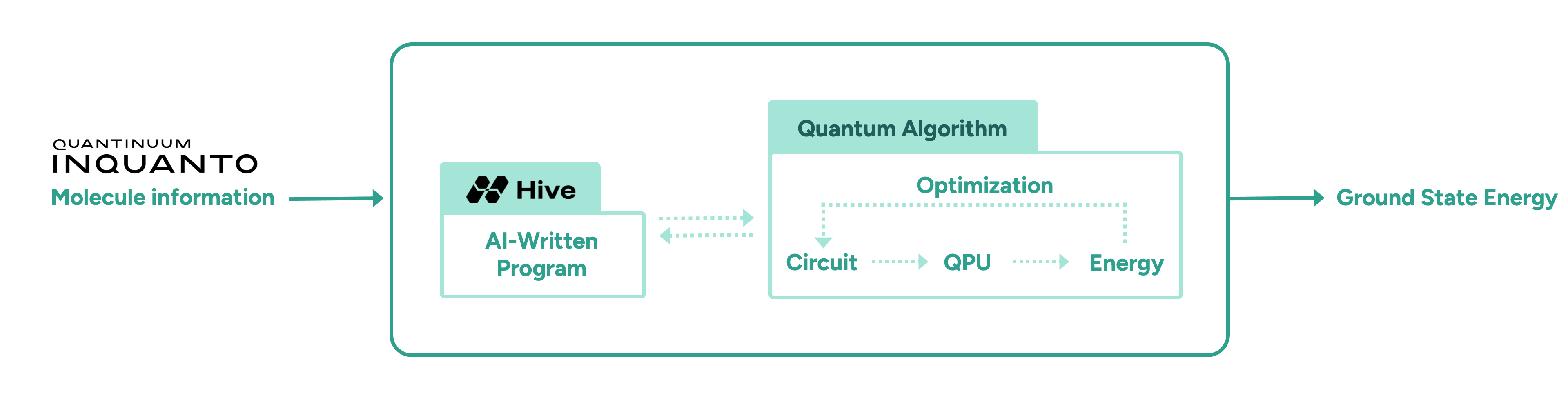
Figure 1: Workflow: A scientist prompts Hiverge's platform, the Hive, with the molecule of interest and a sketch of a quantum algorithm. The goal of the quantum algorithm is to find the ground state energy of the molecule. The Hive evolves the sketch into an efficient version that solves the problem.
The Electronic Structure Problem in Quantum Chemistry

The electronic structure problem is central to quantum chemistry. The goal is to prepare the ground state (the lowest energy state) of a molecule and compute the corresponding energy of that state to chemical precision or beyond. Classically, this is an exponentially hard problem. In particular, classical treatments tend to fall short when there are strong quantum effects in the molecule, and this is where quantum computers may be advantageous.

The paradigm of variational quantum algorithms is motivated by near-term quantum hardware. One starts with a relatively easy-to-prepare initial state. Then, the main part of the algorithm consists of a sequence of parameterised operators representing chemically meaningful actions, such as manipulating electron occupations in the molecular orbitals. These are implemented in terms of parameterised quantum gates. Finally, the energy of the state is measured via the molecule’s energy operator, the “Hamiltonian”, by executing the circuit on a quantum computer and measuring all the qubits on which the circuit is implemented. Taking many measurements, or “shots”, the energy is estimated to the desired precision. The ground state energy is found by iteratively optimising the parameters of the quantum circuit until the energy converges to a minimum value. The general form of such a variational quantum algorithm is illustrated in Figure 2.
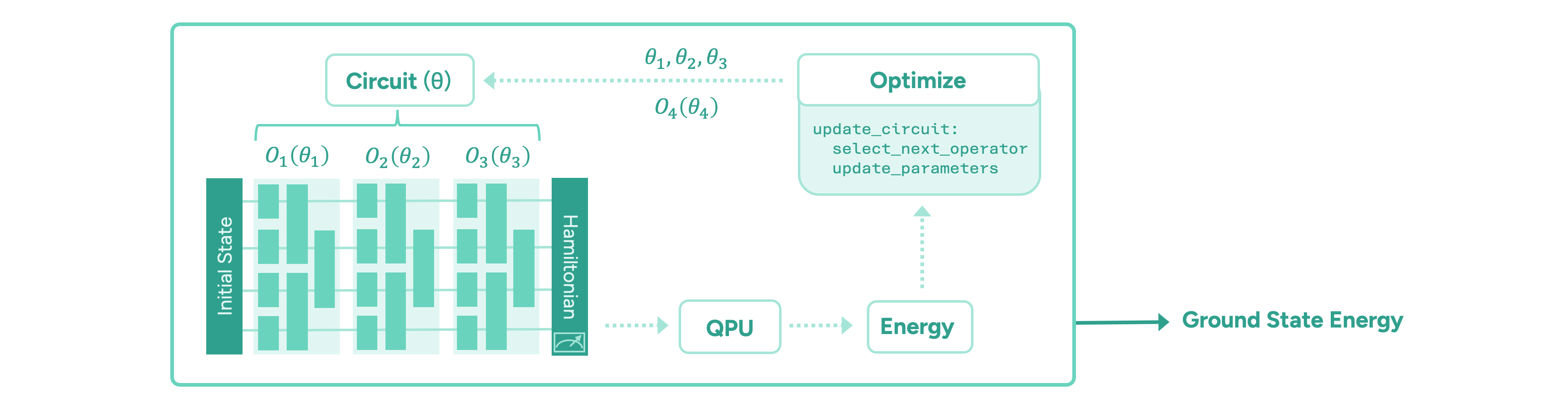
Figure 2: A variational quantum algorithm is defined by a function select_next_operator that iteratively constructs a parameterised quantum circuit as a sequence of operators [O1(θ1),O2(θ2),O3(θ3), ...], and a function update_parameters that optimises its parameters; these functions update the quantum circuit and refine it to its final form that prepares the ground state. The Hive evolves sophisticated versions of these functions starting from trivial versions, written in a familiar programming language, producing a novel, efficient variational quantum algorithm that solves the problem.

The main challenge in these frameworks is to design an appropriate quantum circuit architecture, i.e. find an efficient sequence of operators, and an efficient optimisation strategy for its parameters. It is important to minimise the number of quantum operations in any given circuit, as each operation is inherently noisy and the algorithm’s output degrades exponentially. Another important quantum resource to be minimised is the total number of circuits that need to be evaluated to compute the energy values during the optimisation of the circuit parameters, which is time-consuming.

To meet these challenges, we task the Hive with designing a variational quantum algorithm to solve the ground state problem, following the workflow shown in Figure 1. The Hive is a distributed evolutionary process that evolves programs. It uses Large Language Models to generate mutations in the form of edits to an entire codebase. This genetic process selects the fittest programs according to how well they solve a given problem. In our case, the role of the quantum computer is to compute the fitness, i.e., the ground state energy. Importantly, the Hive operates at the level of a programming language; it readily imports and uses all known libraries that a human researcher would use, including ý’s quantum chemistry platform, InQuanto. In addition, the Hive can accept instructions and requests in natural language, increasing its flexibility. For example, we encouraged it to seek parameter optimisation strategies that avoid estimating gradients, as this incurs significant overhead in terms of circuit evaluations.  Intuitively, the interaction between a human scientist and the Hive is analogous to a supervisor and a group of eager and capable students: the supervisor provides guidance at a high level, and the students collaborate and flesh out the general idea to produce a working solution that the supervisor can then inspect.

We find that from an extremely basic starting point, consisting of a skeleton for a variational quantum algorithm, the Hive can autonomously assemble a bespoke variational quantum algorithm, which we call Hive-ADAPT. Specifically, the Hive evolves heuristic functions that construct a circuit as a sequence of quantum operators and optimise its parameters. Remarkably, the Hive converged on a structure resembling the current state-of-the-art, ADAPT-VQE. Crucially, however, Hive-ADAPT substantially outperforms this baseline, delivering significant improvements in chemical precision while reducing quantum resource requirements.
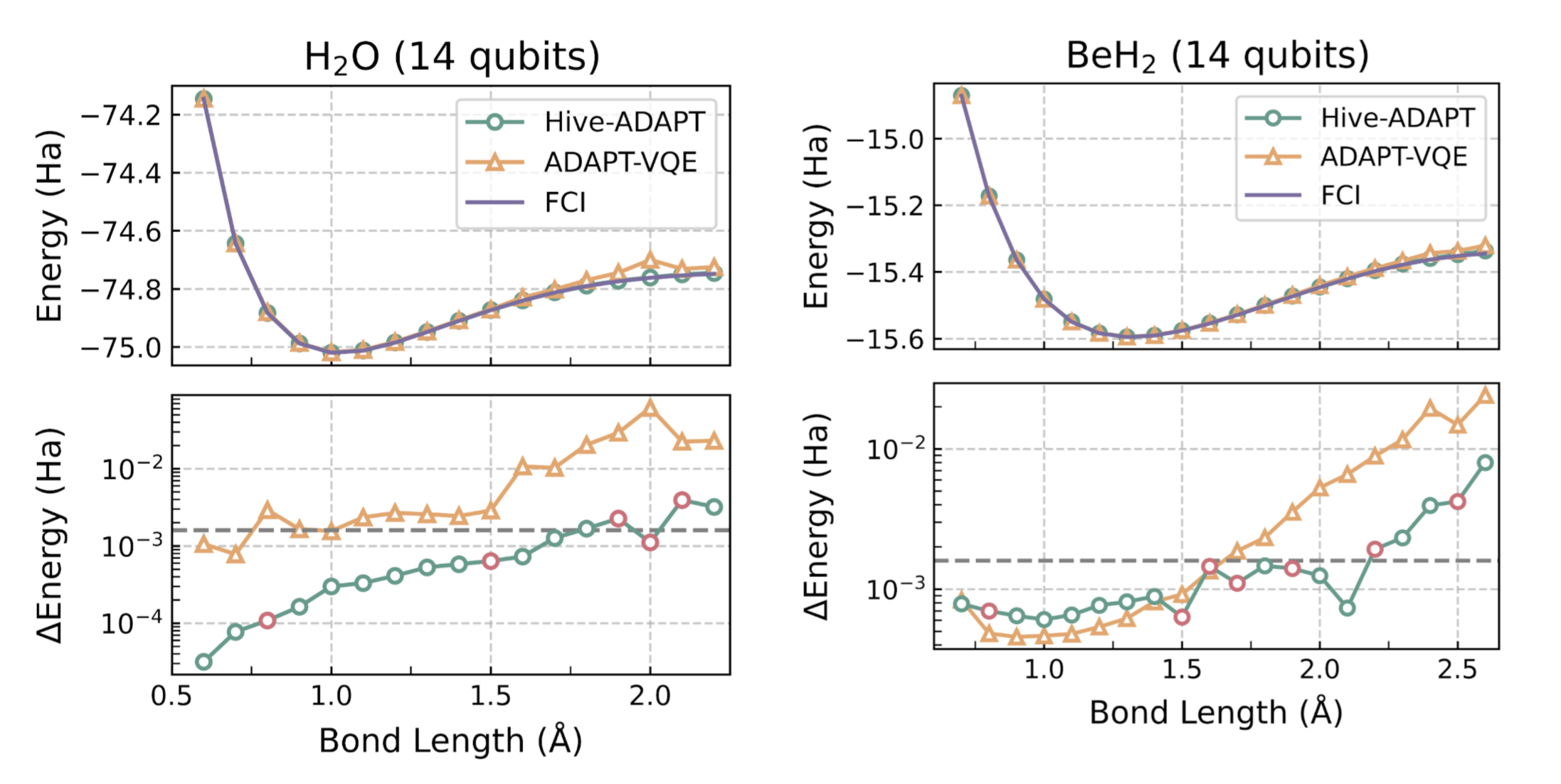
Figure 3: (Top): The measured ground state energy of the molecule in Hartree (Ha) as a function of the bond length in Angstrom (Å), i.e. the length of the O-H and Be-H bonds in H2O and BeH2, respectively. Both ADAPT-VQE and Hive-ADAPT recover the energy curve. (Bottom): The difference between the energy estimated by the quantum algorithms and the reference value computed with the exact FCI method. Hive-ADAPT achieves chemical precision for more bond lengths than ADAPT-VQE (energy below dashed flat lines). Hive-ADAPT was evolved by the Hive to solve a particular set of bond lengths (red circles), and we observe that the same algorithm can also solve the problem on other bond lengths (green circles), showing generalisation over bond lengths.

A molecule’s ground state energy varies with the distances between its atoms, called the “bond length”. For example, for the molecule H2O, the bond length refers to the length of the O-H bond. The Hive was tasked with developing an algorithm for a small set of bond lengths and reaching chemical precision, defined as within 1.6e-3 Hartree (Ha) of the ground state energy computed with the exact Full Configuration Interaction (FCI) algorithm. As we show in Figure 3, remarkably, Hive-ADAPT achieves chemical precision for more bond lengths than ADAPT-VQE. Furthermore, Hive-ADAPT also reaches chemical precision for other “unseen” bond lengths, showcasing the generalisation ability of the evolved quantum algorithm. Our results were obtained from classical simulations of the quantum algorithms, where we used NVIDIA CUDA-Q to leverage the parallelism enabled by GPUs. Further, relative to ADAPT-VQE, Hive-ADAPT exhibits one to two orders of magnitude reduction in quantum resources, such as the number of circuit evaluations and the number of operators used to construct circuits, which is crucial for practical implementations on actual near-term processors.

For molecules such as BeH2 at large Be-H bond lengths, a complex initial state is required for the algorithm to be able to reach the ground state using the available operators. Even in these cases, by leveraging an efficient state preparation scheme implemented in InQuanto, the Hive evolved a dedicated strategy for the preparation of such a complex initial state, given a set of basic operators to achieve the desired chemical precision.

To validate Hive-ADAPT under realistic conditions, we employed ý’s H2 Emulator, which provides a faithful classical simulator of the H2 quantum computer, characterised by a 1.05e-3 two-qubit gate error rate. Leveraging the Hive's inherent flexibility, we adapted the optimisation strategy to explicitly penalise the number of two-qubit gates—the dominant noise source on near-term hardware—by redefining the fitness function. This constraint guided the Hive to discover a noise-aware algorithm capable of constructing hardware-efficient circuits. We subsequently executed the specific circuit generated by this algorithm for the LiH molecule at a bond length of 1.5 Å with the Partition Measurement Symmetry Verification (PMSV) error mitigation procedure. The resulting energy of -7.8767 ± 0.0031 Ha, obtained using 10,000 shots per circuit with a discard rate below 10% in the PMSV error mitigation procedure, is close to the target FCI energy of -7.8824 Ha and demonstrates the Hive's ability to successfully tailor algorithms that balance theoretical accuracy with the rigorous constraints of hardware noise and approach chemical precision as much as possible with current quantum technology.

For illustration purposes, we show an example of an elaborate code snippet evolved by the Hive starting from a trivial version:

ý’s in-house quantum chemistry expert, Dr. David Zsolt Manrique, commented,

“I found it amazing that the Hive converged to a domain-expert level idea. By inspecting the code, we see it has identified the well-known perturbative method, ‘MP2’, as a useful guide; not only for setting the initial circuit parameters, but also for ordering excitations efficiently. Further, it systematically and laboriously fine-tuned those MP2-inspired heuristics over many iterations in a way that would be difficult for a human expert to do by hand. It demonstrated an impressive combination of domain expertise and automated machinery that would be useful in exploring novel quantum chemistry methods.”
Looking to the Future

In this initial proof-of-concept collaborative study between ý and Hiverge, we demonstrate that AI-driven algorithm discovery can generate efficient quantum heuristics. Specifically, we found a great reduction in quantum resources, which is impactful for quantum algorithmic primitives that are frequently reused. Importantly, this approach is highly flexible; it can accommodate the optimisation of any desired quantum resource, from circuit evaluations to the number of operations in a given circuit. This work opens a path toward fully automated pipelines capable of developing problem-specific quantum algorithms optimised for NISQ as well as future hardware.

An important question for further investigation regards transferability and generalisation of a discovered quantum solution to other molecules, going beyond the generalisation over bond lengths of the same molecule that we have already observed. Evidently, this approach can be applied to improving any other near-term quantum algorithm for a range of applications from optimisation to quantum simulation.

We have already demonstrated an error-corrected implementation of quantum phase estimation on quantum hardware, and an AI-driven approach promises further hardware-tailored improvements and optimal use of quantum resources. Beyond NISQ, we envision that AI-assisted algorithm discovery will be a fruitful endeavour in the fault-tolerant regime, as well, where high-level quantum algorithmic primitives (quantum fourier transform, amplitude amplification, quantum signal processing, etc.) are to be combined optimally to achieve computational advantage for certain problems.

Notably, we’ve entered an era where quantum algorithms can be written in high-level programming languages, like ý’s , and approaches that integrate Large Language Models directly benefit. Automated algorithm discovery is promising for improving routines relevant to the full quantum stack, for example, in low-level quantum control or in quantum error correction.
technical
All
Blog
|
partnership
November 17, 2025
ý Powering Hybrid Quantum AI Supercomputing with NVIDIA

ý is focusing on redefining what’s possible in hybrid quantum–classical computing by integrating ý’s best-in-class systems with high-performance NVIDIA accelerated computing to create powerful new architectures that can solve the world’s most pressing challenges. 

The launch of Helios, Powered by Honeywell, the world’s most accurate quantum computer, marks a major milestone in quantum computing. Helios is now available to all customers through the cloud or on-premise deployment, launched with a go-to-market offering that seamlessly pairs Helios with the , targeting specific end markets such as drug discovery, finance, materials science, and advanced AI research. 

We are also working with NVIDIA to adopt  , an open system architecture, as a standard for advancing hybrid quantum-classical supercomputing. Using this technology with ý Guppy and the , ý has implemented NVIDIA accelerated computing across Helios and future systems to perform real-time decoding for quantum error correction. 

In an industry-first demonstration, an NVIDIA GPU-based decoder integrated in the Helios control engine improved the logical fidelity of quantum operations by more than 3% — a notable gain given Helios’ already exceptionally low error rate. These results demonstrate how integration with NVIDIA accelerated computing through NVQLink can directly enhance the accuracy and scalability of quantum computation.

This unique collaboration spans the full ý technology stack. ý’s next-generation software development environment allows users to interleave quantum and GPU-accelerated classical computations in a single workflow. Developers can build hybrid applications using tools such as NVIDIA CUDA-Q, , and ý’s Guppy, to make advanced quantum programming accessible to a broad community of innovators.

The collaboration also reaches into applied research through the (NVAQC), where an NVIDIA GB200 NVL72 supercomputer can be paired with ý’s Helios to further drive hybrid quantum-GPU research, including  the development of breakthrough quantum-enhanced AI applications.

A recent achievement illustrates this potential: The ADAPT-GQE framework, a transformer-based Generative Quantum AI (GenQAI) approach, uses a Generative AI model to efficiently synthesize circuits to prepare the ground state of a chemical system on a quantum computer. Developed by ý, NVIDIA, and a pharmaceutical industry leader—and leveraging NVIDIA CUDA-Q with GPU-accelerated methods—ADAPT-GQE achieved a 234x speed-up in generating training data for complex molecules. The team used the framework to explore imipramine, a molecule crucial to pharmaceutical development. The transformer was trained on imipramine conformers to synthesize ground state circuits at orders of magnitude faster than ADAPT-VQE, and the circuit produced by the transformer was run on Helios to prepare the ground state using InQuanto, ý's computational chemistry platform.

From collaborating on hardware and software integrations to GenQAI applications, the collaboration between ý and NVIDIA is building the bridge between classical and quantum computing and creating a future where AI becomes more expansive through quantum computing, and quantum computing becomes more powerful through AI.

partnership
All
Blog
|
technical
November 13, 2025
From Memory to Logic

By Dr. Noah Berthusen

The earliest works on quantum error correction showed that by combining many noisy physical qubits into a complex entangled state called a "logical qubit," this state could survive for arbitrarily long times. QEC researchers devote much effort to hunt for codes that function well as "quantum memories," as they are called. Many promising code families have been found, but this is only half of the story.

Being able to keep a qubit around for a long time is one thing, but to realize the theoretical advantages of quantum computing we need to run quantum circuits. And to make sure noise doesn't ruin our computation, these circuits need to be run on the logical qubits of our code. This is often much more challenging than performing gates on the physical qubits of our device, as these "logical gates" often require many physical operations in their implementation. What's more, it often is not immediately obvious which logical gates a code has, and so converting a physical circuit into a logical circuit can be rather difficult.

Some codes, like the famous , are good quantum memories and also have easy logical gates. The drawback is that the ratio of physical qubits to logical qubits (the "encoding rate") is low, and so many physical qubits are required to implement large logical algorithms. High-rate codes that are good quantum memories have also been found, but computing on them is much more difficult. The holy grail of QEC, so to speak, would be a high-rate code that is a good quantum memory and also has easy logical gates. Here, we make progress on that front by developing a new code with those properties.

Building on prior error correcting codes

A recent work from ý QEC researchers introduced . The underlying construction method for these codes, called the "symplectic double cover," also provided a way to obtain logical gates that are well suited for ý's QCCD architecture. Namely, these "SWAP-transversal" gates are performed by applying single qubit operations and relabeling the physical qubits of the device. Thanks to the all-to-all connectivity facilitated through qubit movement on the QCCD architecture, this relabeling can be done in software essentially for free. Combined with extremely high fidelity (~1.2 x10⁻⁵) single-qubit operations, the resulting logical gates are similarly high fidelity.

Given the promise of these codes, we take them a step further in our . We combine the symplectic double codes with the [[4,2,2]] Iceberg code using a procedure called "code concatenation". A concatenated code is a bit like nesting dolls, with an outer code containing codes within it---with these too potentially containing codes. More technically, in a concatenated code the logical qubits of one code act as the physical qubits of another code.

The new codes, which we call "concatenated symplectic double codes", were designed in such a way that they have many of these easily-implementable SWAP-transversal gates. Central to its construction, we show how the concatenation method allows us to "upgrade" logical gates in terms of their ease of implementation; this procedure may provide insights for constructing other codes with convenient logical gates. Notably, the SWAP-transversal gate set on this code is so powerful that only two additional operations (logical T and S) are necessary for universal computation. Furthermore, these codes have many logical qubits, and we also present numerical evidence to suggest that they are good quantum memories.

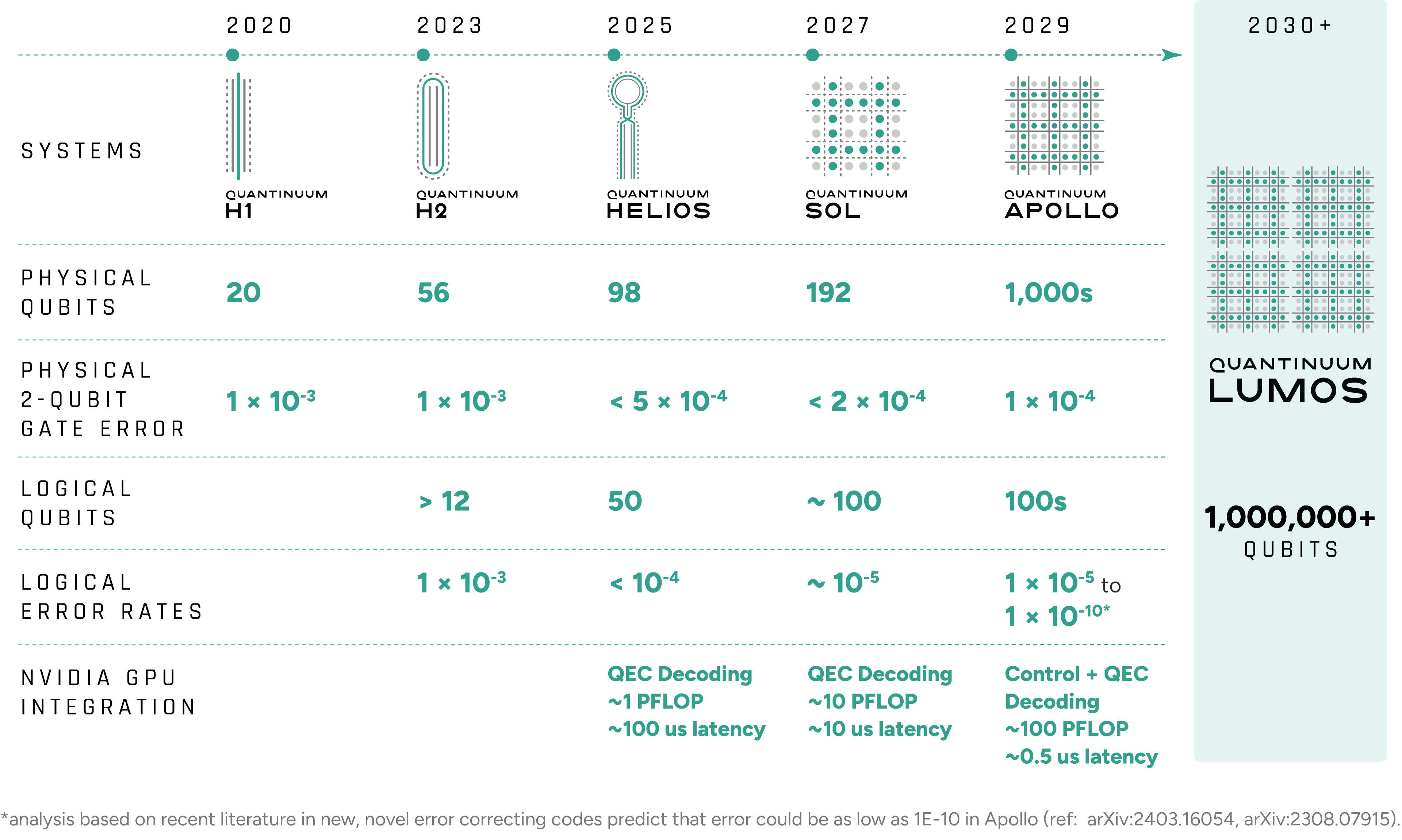
Concatenated symplectic double codes have one of the easiest logical computation schemes, and we didn’t have to sacrifice rate to achieve it. Looking forward in our roadmap, we are targeting hundreds of logical qubits at ~ 1x 10⁻⁸ logical error rate by 2029. These codes put us in a prime position to leverage the best characteristics of our hardware and create a device that can achieve real commercial advantage.

technical
All